
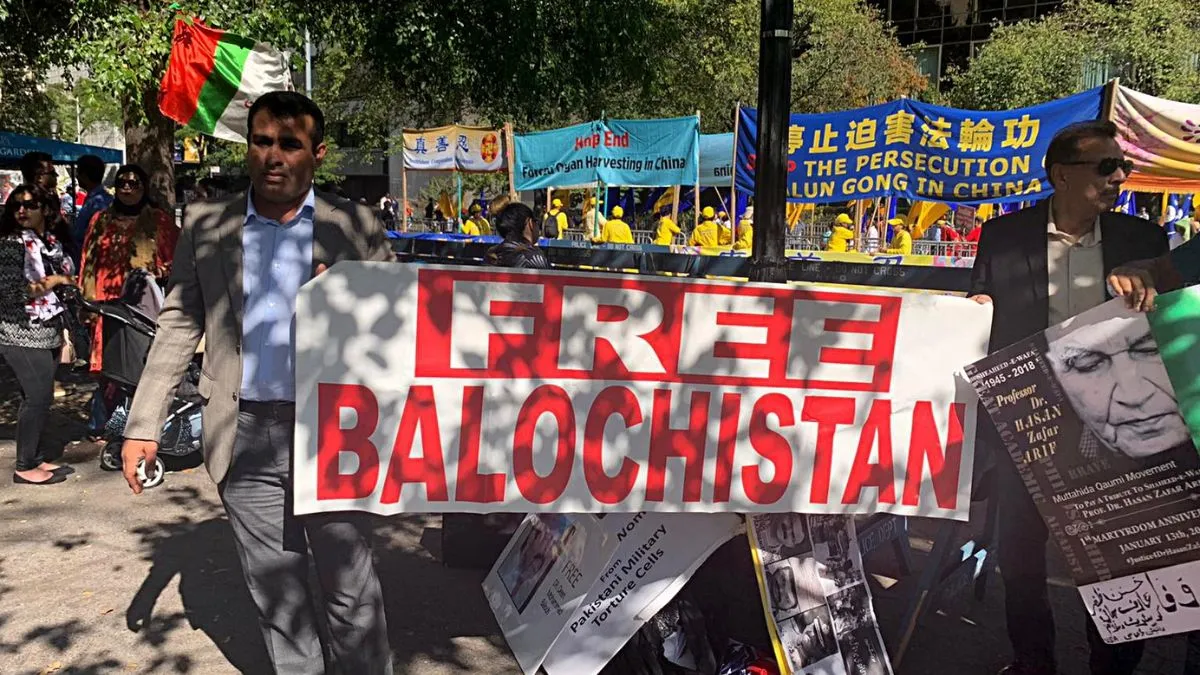
In light of renewed debates and discussions about Balochistan within the politics of South Asia, there is a certain date that comes to prominence on a regular basis: August 11. Each year, numerous Baloch national movements celebrate this day as the Independence Day of Balochistan, because it denotes the brief period of time when the Khanate of Kalat existed as an independent state prior to joining Pakistan.
Recently, Baloch representative and diplomat Mir Yar Baloch took to X (formerly Twitter) and shared, "The Republic of Balochistan announces worldwide celebrations of August 11 as the Independence Day of Balochistan with national unity."
While the Baloch nationalists observe August 11 as marking the day of independence for their land, Pakistan claims the legitimacy of its accession in 1948.
Why is August 11 significant?
The significance of August 11 dates back to 1947, just days before British India was partitioned into India and Pakistan. At the time, present-day Balochistan was not a single political unit. It consisted of British-administered Balochistan and several princely states, the most prominent being the Khanate of Kalat, along with Kharan, Las Bela and Makran.
On August 11, 1947, an agreement involving the British, Pakistan and the Khan of Kalat recognised Kalat as having a constitutional status distinct from that of other princely states. Many historians note that Pakistan initially acknowledged Kalat's separate status while negotiations over its future continued. Baloch nationalist groups interpret this as recognition of Kalat's independence.
What was the Khanate of Kalat?
The Khanate of Kalat was a princely state ruled by the Khan of Kalat under British paramountcy. Although it maintained considerable internal autonomy, its relationship with the British differed from many other princely states because of earlier treaties. When British rule ended in August 1947, Kalat's leadership sought to remain independent rather than immediately join Pakistan.
What happened after August 1947?
The period of uncertainty lasted only a few months. Negotiations between Kalat and Pakistan continued through late 1947 and early 1948. During this time, Pakistan argued that Kalat should accede to the new country, while the Khan initially resisted immediate accession. On March 27, 1948, the Khan of Kalat signed the Instrument of Accession, formally joining Pakistan. Soon afterwards, his brother Prince Abdul Karim launched an armed rebellion, widely regarded as the first Baloch insurgency.
Why do Baloch nationalists still observe August 11?
For many Baloch nationalist organisations, August 11 symbolises a lost sovereignty. They argue that Kalat functioned as an independent state between August 1947 and March 1948 and contend that its subsequent accession to Pakistan was made under pressure. Every year, Baloch groups inside Pakistan and in the diaspora organise events, issue statements and fly the Baloch flag to commemorate what they describe as Independence Day.
Pakistan's position
Pakistan disputes this interpretation. The Pakistani government's position is that Kalat, like other princely states under British paramountcy, ultimately had to accede to either India or Pakistan after Partition. It argues that the accession signed by the Khan of Kalat in March 1948 was a valid constitutional process and rejects claims that Balochistan was an independent country later annexed.
Why does the issue remain important today?
August 11 debate is not only a matter of history but rather a matter of identity, autonomy, and self-determination for many Baloch nationalist factions, while for Pakistan it is seen as a constitutional issue related to the integrity of its territory.
After more than seven decades since the incident, the events of that time still shape political discourse; therefore, the date of August 11 becomes one of the most symbolic dates in the history of Balochistan.
Also read:
