
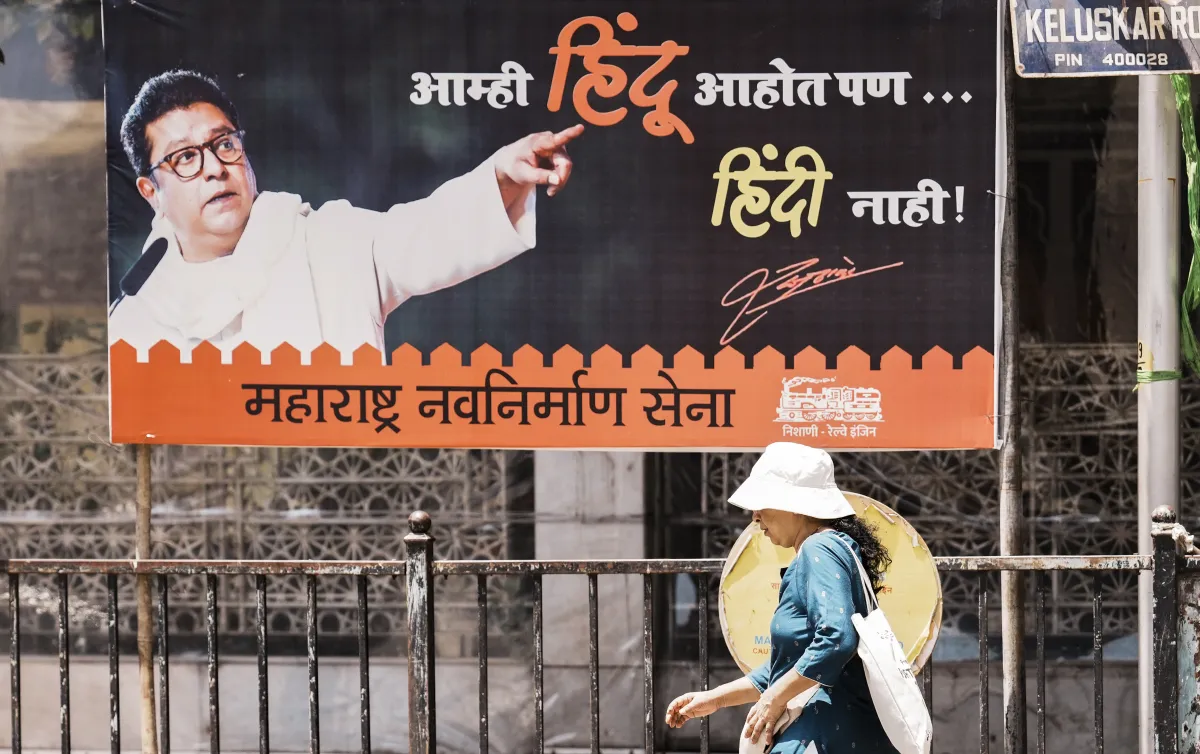
Amid growing criticism, the Maharashtra government’s language consultation committee has urged Chief Minister Devendra Fadnavis to withdraw the decision to make Hindi a compulsory third language for students in Classes 1 to 5. The move, approved under the National Education Policy (NEP), has triggered allegations of linguistic imposition, particularly from opposition parties.
In a letter to the chief minister on Sunday, committee chairman Laxmikant Deshmukh claimed the State Council of Educational Research and Training (SCERT) ignored the panel’s advice while formulating the language policy. The committee argued that making Hindi mandatory contradicts the NEP, which does not prescribe any compulsory language and advocates education in the mother tongue. “Hindi should not be made mandatory at any stage. In fact, its use should be minimised,” the letter said, adding that Hindi “is not the language of employment, income, prestige or knowledge” in the state.
The opposition Shiv Sena (UBT) and Maharashtra Navnirman Sena (MNS) have accused the BJP-led government of imposing Hindi in a state where Marathi holds official primacy.
No Hindi imposition: CM Fadnavis
Reacting to the criticism, Fadnavis dismissed claims of Hindi imposition. Speaking to reporters in Pune, he reiterated that Marathi would remain compulsory and central to education in Maharashtra. “It is wrong to say that Hindi is being imposed,” Fadnavis said. “Marathi is and will remain a must. There will be no other compulsion.”
He explained that the NEP requires students to learn three languages, two of which must be Indian. Since Marathi is already compulsory in the state, the government has opted for Hindi as the third, he said, citing the availability of trained teachers. “You cannot choose a foreign language in place of an Indian one. Among Indian languages, Hindi, Tamil, Malayalam, and Gujarati are options, but not all have teacher availability,” Fadnavis said.
He also questioned the broader preference for English over Indian languages. “We oppose Indian languages like Hindi but praise English. Why is that?” he asked.
(With PTI inputs)
