
Advertisement
  1. Home
  2. Lifestyle
  3. Spirituality
  4. Total solar eclipse 2026 highlights: Stunning views from Iceland and Spain, NASA experiment and more

Total solar eclipse 2026 highlights: Stunning views from Iceland and Spain, NASA experiment and more

Written By: Amman Khurana
Updated:

Total solar eclipse 2026 highlights: Catch the key moments from the rare celestial event as totality swept across Iceland and Spain, while NASA tracked the eclipse using its WB-57 aircraft and scientific balloon experiments.

Total solar eclipse 2026 LIVE
Total solar eclipse 2026 LIVE Image Source : Youtube/NASA
New Delhi:

The total solar eclipse of 2026 has delivered a spectacular celestial show, with the Moon passing directly in front of the Sun and creating a brief period of darkness along the path of totality. The eclipse crossed northern Russia, Greenland, Iceland, the Atlantic Ocean and Spain, while large parts of Europe, North America and northwestern Africa witnessed a partial solar eclipse.

From stunning views of the eclipse in Iceland and Spain to NASA's live coverage and scientific experiments, the event offered both a visual spectacle and a valuable opportunity for researchers. NASA's WB-57 aircraft studied the Sun's corona from high altitude, while the Nationwide Eclipse Ballooning Project launched scientific balloons in Iceland and Spain to examine how the sudden drop in sunlight affects Earth's atmosphere.

 

Total solar eclipse 2026 highlights

Auto Refresh
Refresh
  • 11:40 PM (IST)
    Posted by Shivani Dixit

    Why is a solar eclipse important?

    A solar eclipse is important not only because it is a rare and spectacular astronomical event, but also because it gives scientists a valuable opportunity to study the Sun and its effects on Earth. During a total solar eclipse, the Moon temporarily blocks the Sun's bright surface, allowing researchers to observe the solar corona, the Sun's outer atmosphere, which is normally difficult to see.

    Solar eclipses also help scientists study how the Earth's atmosphere responds to sudden changes in sunlight. The temporary drop in solar heating can cause changes in temperature, winds and other atmospheric conditions. This is why researchers use eclipses to conduct experiments with telescopes, aircraft, balloons and other scientific instruments.

  • 11:27 PM (IST)
    Posted by Shivani Dixit

    NASA-supported balloon project takes to Iceland during total solar eclipse

    A NASA-supported team from the Nationwide Eclipse Ballooning Project (NEBP) is launching scientific weather balloons in Iceland before, during and after the August 12 total solar eclipse. The project is designed to study how the sudden drop in sunlight affects Earth's atmosphere, particularly the atmospheric boundary layer close to the ground.

    Two teams in Iceland are expected to launch around 80 balloons, with measurements collected from about 18 hours before the eclipse until eight hours after it. The balloons carry instruments that record atmospheric conditions, helping scientists understand how temperature, pressure, wind and other atmospheric properties respond to the brief darkness created by the eclipse.

    The balloon launches are part of a wider NASA-supported scientific effort, with teams also operating in Spain to study the atmospheric effects of the rare celestial event.

  • 11:22 PM (IST)
    Posted by Shivani Dixit

    Partial solar eclipse seen in Norway

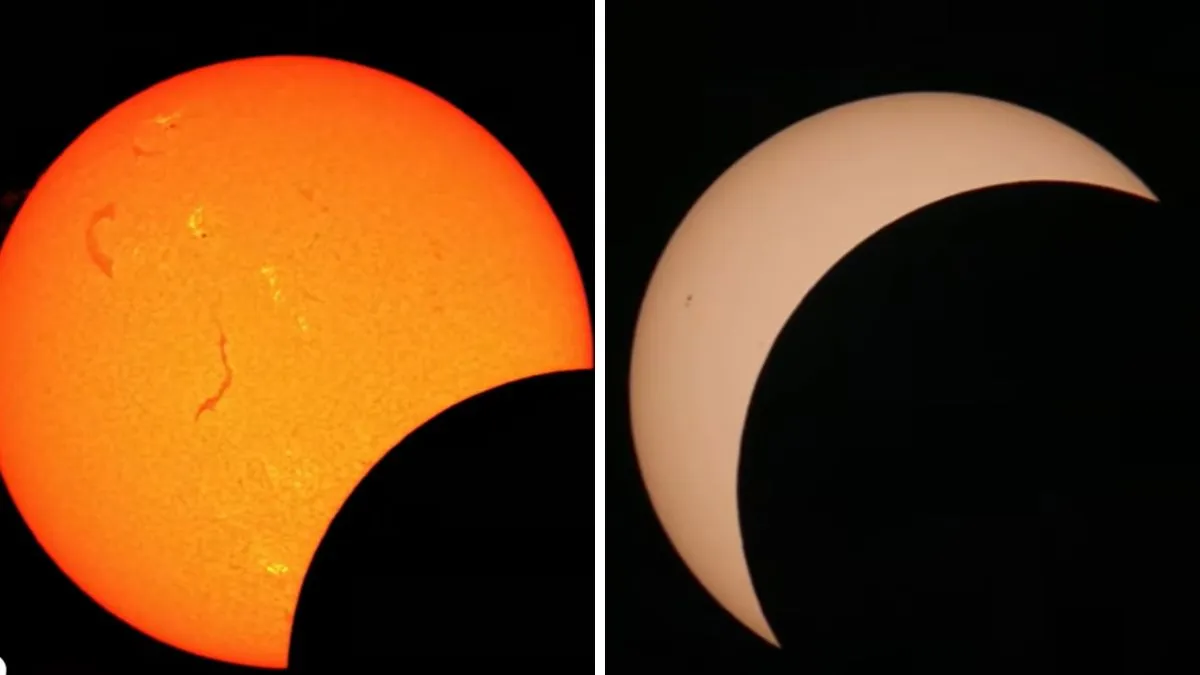
    The image shows the partial solar eclipse as seen from Norway, with the Moon covering a large section of the Sun’s disc. Norway is outside the path of totality, so observers there see only a partial eclipse.

    In Oslo, the partial eclipse began at around 7:02 pm local time and continued until approximately 8:49 pm, with the Moon creating a striking crescent-like appearance of the Sun.

  • 11:21 PM (IST)
    Posted by Shivani Dixit

    Partial solar eclipse visible in Spain

    The image shows the partial phase of the solar eclipse as seen from Spain, with the Moon appearing to cover a significant portion of the Sun's disc. Spain is also within the path of totality, meaning observers in parts of northern Spain can see the Moon completely cover the Sun for a brief period.

    As the eclipse progresses, the Moon gradually moves further across the Sun before reaching totality in parts of the country. The event is taking place close to sunset in Spain, making the timing and viewing conditions particularly significant for observers.

  • 11:20 PM (IST)
    Posted by Shivani Dixit

    Totality hits Iceland as 2026 solar eclipse sweeps across the country

    The total solar eclipse has reached Iceland, with the Moon completely covering the Sun along the path of totality. Western Iceland is among the select locations experiencing totality during the August 12, 2026 eclipse.

    The eclipse will continue its journey across the North Atlantic before reaching northern Spain, where observers will also witness totality. The maximum duration of totality is about 2 minutes and 18 seconds, occurring just west of Iceland. 

  • 11:15 PM (IST)
    Posted by Shivani Dixit

    How does the climate change during a solar eclipse?

    During a solar eclipse, the temporary blocking of sunlight can cause short-term changes in local weather conditions. As the Sun’s rays are reduced, the ground receives less heat, which can lead to a noticeable drop in temperature. The extent of the change depends on the duration and degree of the eclipse.

    The sudden cooling can also influence wind speed, humidity and atmospheric pressure. Local winds may briefly weaken or change direction as the air near the surface cools. In some areas, changes in cloud formation have also been observed during major eclipses.

    These weather changes are temporary and localised. As sunlight returns after the eclipse, temperatures and atmospheric conditions generally begin to return to their normal pattern.

  • 11:05 PM (IST)
    Posted by Shivani Dixit

    Partial solar eclipse visible in Spain

    A partial solar eclipse is visible in parts of Spain, as the Moon passes in front of the Sun and covers only a portion of its disc. The celestial event is part of the wider eclipse that is being observed across several regions.

  • 10:47 PM (IST)
    Posted by Shivani Dixit

    NASA starts live coverage as total solar eclipse begins

    NASA has begun its live coverage of the 2026 total solar eclipse, offering viewers telescope views, expert commentary and footage from its WB-57 research aircraft flying high above the eclipse path.

  • 10:18 PM (IST)
    Posted by Shivani Dixit

    NASA’s live solar eclipse coverage to begin at 10:45 pm IST

    NASA’s live coverage of the eclipse is scheduled to begin at 10:45 pm IST, featuring telescope views, expert commentary and footage captured by a NASA WB-57 research aircraft flying at high altitude over the eclipse path.

  • 9:39 PM (IST)
    Posted by Shivani Dixit

    NASA captures solar eclipse view from the International Space Station

    NASA’s live stream from the International Space Station (ISS) is offering viewers a unique perspective from space as the 2026 total solar eclipse unfolds. The official NASA stream features views from cameras positioned outside the space station, giving viewers a glimpse of the celestial event from orbit. The live broadcast also includes views from inside the ISS and footage of Earth, although occasional transmission interruptions can occur due to communication conditions.

  • 9:16 PM (IST)
    Posted by Shivani Dixit

    The total solar eclipse of 2026 is officially underway

    The Moon has begun passing in front of the Sun, marking the start of today's spectacular celestial event. The eclipse began in northern Siberia, close to the North Pole, and will gradually move southeastwards across Greenland, Iceland and northern Spain in the coming hours. The event will eventually end around sunset over the Mediterranean Sea.

  • 9:04 PM (IST)
    Posted by Shivani Dixit

    Belief about eclipses in China

    According to ancient Chinese beliefs, an eclipse occurred when a celestial dragon tried to swallow the Sun. To drive the dragon away, people would traditionally make loud noises by banging pots and drums during an eclipse.

  • 9:00 PM (IST)
    Posted by Shivani Dixit

    Food rules during a solar eclipse

    According to traditional beliefs, basil leaves (Tulsi) or sacred Kusha grass should be added to water, milk and cooked food before a solar eclipse. It is believed that doing so protects the food from the harmful effects or negative energies associated with the eclipse, allowing it to be consumed later.

  • 7:32 PM (IST)
    Posted by Shivani Dixit

    Religious reasons behind solar eclipses in India

    According to Hindu mythology, when the ocean was churned, a pot of nectar of immortality emerged. Rahu secretly disguised himself and drank the nectar. The Sun and the Moon realised what had happened and immediately informed Lord Vishnu.

    Lord Vishnu then used his Sudarshan Chakra to sever Rahu's head from his body. Since Rahu had already consumed the nectar, he did not die. Instead, his body was divided into two parts. The head became immortal as Rahu, while the body became Ketu.

    According to religious beliefs, Rahu and Ketu developed hostility towards the Sun and the Moon because they had revealed Rahu's deception to Lord Vishnu. It is believed that from time to time, Rahu and Ketu attempt to swallow the Sun, which is considered the mythological explanation for a solar eclipse.

  • 7:07 PM (IST)
    Posted by Shivani Dixit

    Where will the partial solar eclipse be visible?

    The partial solar eclipse will be visible across more than 70 countries in parts of Europe, Africa and the Americas. Here are some of the countries where the partial solar eclipse will be visible:

    Europe: United Kingdom (UK), Ireland, the Netherlands, Switzerland, France, Germany, Italy, Sweden, Poland, Greece, Austria and others.

    North and South America: United States (USA), Brazil, Canada, Bermuda and others.

    Africa: Morocco, Senegal, Ghana, Algeria, Tunisia, Niger and others.

  • 5:09 PM (IST)
    Posted by Shivani Dixit

    Surya Grahan 2026 Live: Exact timing of the solar eclipse

    This solar eclipse will take place at night according to Indian Standard Time (IST). The eclipse will follow this timeline:

    • Partial eclipse begins: 9:04 pm
    • Total eclipse begins: 10:28 pm
    • Greatest eclipse: 11:16 pm
    • Total eclipse ends: 12:04 am
    • Eclipse ends: 1:28 am 
     
     
  • 4:41 PM (IST)
    Posted by Shivani Dixit

    How can the eclipse be viewed?

    NASA, the European Space Agency (ESA) and various international astronomical observatories are streaming the eclipse live on their YouTube channels and websites, allowing you to watch it online.

  • 3:45 PM (IST)
    Posted by Shivani Dixit

    Will Sutak Kaal be observed in India?

    No, Sutak Kaal will not be observed in India. According to the rules of Vedic astrology, Sutak Kaal and its associated religious practices are considered applicable only when a solar or lunar eclipse is directly visible in a particular region. Since this eclipse will not be visible in India, Sutak Kaal will not be observed here.


  • 3:04 PM (IST)
    Posted by Amman Khurana

    How is a Surya Grahan formed?

    A Surya Grahan occurs when the Moon moves between the Sun and Earth as it orbits the Earth. The Moon then blocks some or all of the Sun's light from reaching Earth for a short period, causing darkness in some parts of the planet.

    A solar eclipse occurs only on Amavasya, or the New Moon, when the Moon is positioned between the Sun and Earth.

  • 2:18 PM (IST)
    Posted by Amman Khurana

    Will temples remain open and do food rules apply?

    Since Surya Grahan is not visible in India, the traditional religious rules associated with the eclipse do not need to be followed here. Temples will remain open as usual, while those who wish to engage in spiritual practices can chant mantras or meditate according to their preference.

  • 1:37 PM (IST)
    Posted by Amman Khurana

    When will the next solar eclipse occur?

    The next solar eclipse after August 12, 2026, will take place on February 6, 2027. The second solar eclipse of 2027 is scheduled for August 2. This means the August 12 eclipse will be the last solar eclipse of 2026.

  • 1:05 PM (IST)
    Posted by Amman Khurana

    Surya Grahan 2026: Which zodiac signs may see positive effects?

    According to astrological beliefs, Surya Grahan is not expected to have a negative impact on some zodiac signs. Aries, Gemini and Libra natives may see positive developments in different areas of their lives.

    • Aries: The eclipse is not expected to have a negative impact on Aries. There may be chances of recovering stuck money, while progress at work and career growth could also bring happiness.
    • Gemini: Gemini natives may see an improvement in their financial situation. There are also chances of gains in business, along with better decision-making abilities. Overall, the period is considered favourable.
    • Libra: The influence of Chaturgrahi Yog and Jupiter could give Libra natives a new direction in their careers. They may get new opportunities for gains at work and could also be entrusted with a major responsibility. Their financial position may become stronger.
  • 12:54 PM (IST)
    Posted by Amman Khurana

    Surya Grahan 2026: Chaturgrahi Yog forms on the day of the solar eclipse

    According to astrology, an auspicious Chaturgrahi Yog is forming on the day of Surya Grahan. On August 12, the Sun, Mercury, Jupiter and Moon will all be positioned in Cancer, creating this four-planet alignment.

    As per astrological beliefs, people born under Aries, Gemini, Libra and Sagittarius may benefit significantly from this planetary combination.

  • 12:27 PM (IST)
    Posted by Amman Khurana

    Which mantras should you chant during the Surya Grahan?

    According to traditional beliefs, chanting mantras during Surya Grahan is considered auspicious. Devotees can recite the following mantras during the eclipse:

    • ॐ ह्रां ह्रीं ह्रौं सः सूर्याय नमः॥
    • ॐ घृणिः सूर्याय नमः॥
    • ॐ त्र्यम्बकं यजामहे सुगन्धिं पुष्टिवर्धनम्। उर्वारुकमिव बन्धनान्मृत्योर्मुक्षीय माऽमृतात्॥
    • ॐ भूर्भुवः स्वः तत्सवितुर्वरेण्यं भर्गो देवस्य धीमहि धियो यो नः प्रचोदयात्॥
    • ॐ नमः शिवाय
  • 12:01 PM (IST)
    Posted by Amman Khurana

    When did the first solar eclipse of the year occur?

    The first solar eclipse of 2026 took place on February 17, coinciding with Phalgun Amavasya. It was an annular solar eclipse, also known as a 'Ring of Fire' eclipse.

    The eclipse was not visible from India, as the Sun was below the horizon across the country during the event.

  • 11:44 AM (IST)
    Posted by Amman Khurana

    Surya Grahan: What should you do during the solar eclipse?

    According to traditional beliefs, devotees can follow these practices during Surya Grahan:

    • Chant God's name, meditate and engage in prayer.
    • Chant the Surya Mantra.
    • Make donations.
    • Take a bath after the eclipse ends.
    • Chant the Maha Mrityunjaya Mantra.
  • 11:17 AM (IST)
    Posted by Amman Khurana

    Surya Grahan 2026: How can you watch the solar eclipse live from home?

    The Surya Grahan will not be visible from India, but you can still watch it from home through live streams. The eclipse can be viewed on your mobile phone or TV via NASA's official YouTube channel, Space.com and live streams from major observatories around the world from 11:45 pm.

  • 10:45 AM (IST)
    Posted by Amman Khurana

    Surya Grahan 2026: What time will the solar eclipse start and end today?

    The partial solar eclipse will begin at 9:04 pm, followed by the start of the total solar eclipse at 10:28 pm. The eclipse will reach its peak at 11:16 pm, with totality lasting around 2 minutes and 18 seconds near the central path.

    The eclipse will reach its maximum point over Reykjavik, Iceland, at 11:18 pm, while the total eclipse will reach Spain at 11:57 pm. The total phase will end globally at 12:04 am, while the partial solar eclipse will finally end at 1:28 am.

  • 10:17 AM (IST)
    Posted by Amman Khurana

    Which kind of solar eclipse is taking place today?

    A total solar eclipse is taking place today. The eclipse has a magnitude of 1.039, which means that at the point of maximum eclipse, the Sun will be completely covered by the Moon's shadow.

  • 9:57 AM (IST)
    Posted by Amman Khurana

    Where will the solar eclipse be visible?

    The total solar eclipse will be visible from parts of the Arctic, Greenland, Iceland and Spain. The partial solar eclipse will be visible across northern parts of North America, most of Europe, north-western Africa, the Arctic Ocean and the North Atlantic Ocean.

  • 9:30 AM (IST)
    Posted by Amman Khurana

    What should you do after the Surya Grahan?

    According to traditional beliefs, the house should be cleaned after Surya Grahan, followed by sprinkling Gangajal throughout the home. Gangajal should also be sprinkled over the idols and pictures of deities kept in the home temple, followed by bathing them.

    After the solar eclipse, people are also advised to donate and feed green fodder to a cow. Pregnant women, in particular, are advised to take a bath after the eclipse ends.

  • 8:55 AM (IST)
    Posted by Amman Khurana

    Surya Grahan: Can you cook food during the solar eclipse?

    According to traditional beliefs, food should not be cooked during Surya Grahan. If there is a young child, elderly person or someone who is unwell at home, food can be prepared in advance before the eclipse. Tulsi leaves can also be added to cooked food. Children and people who are weak are traditionally allowed to eat light food with tulsi leaves during the eclipse.

  • 8:39 AM (IST)
    Posted by Amman Khurana

    Which mantra should you chant during the Surya Grahan?

    During Surya Grahan, devotees can chant the mantra "ॐ ह्रां ह्रीं हौं स: सूर्याय नम:" at least 108 times. The mantra "ॐ घृणिः सूर्याय नमः" can also be recited. According to traditional beliefs, chanting these mantras helps protect a person from the negativity believed to spread during the eclipse.

  • 8:37 AM (IST)
    Posted by Amman Khurana

    Can you bathe during the solar eclipse?

    According to traditional beliefs, bathing during the eclipse should be avoided. Instead, people are advised to take a bath after the eclipse ends, as it is believed to help cleanse away the negative effects of the eclipse.

  • 8:13 AM (IST)
    Posted by Amman Khurana

    Can you sleep during the solar eclipse?

    According to traditional beliefs, one should avoid sleeping during the solar eclipse. However, taking some rest is considered fine. During the eclipse, people are advised to spend the time quietly remembering or meditating on God.

  • 7:49 AM (IST)
    Posted by Amman Khurana

    What should pregnant women do during the Surya Grahan?

    According to traditional beliefs, pregnant women are advised to chant their Ishta Dev's mantra or the Mahamrityunjaya Mantra during the eclipse. It is also believed that taking a bath immediately after the eclipse ends can help cleanse away any negative effects.

  • 7:38 AM (IST)
    Posted by Amman Khurana

    What should you avoid during the sutak period of Surya Grahan?

    According to traditional Hindu beliefs, certain activities are considered best avoided during the sutak period of a solar eclipse:

    • Avoid auspicious ceremonies such as weddings, housewarming ceremonies and mundan, as well as starting a new venture.
    • Avoid cooking or eating food during the eclipse.
    • If food has already been prepared, it is traditionally kept with a few tulsi leaves.
    • Avoid cutting your hair, shaving or getting an oil massage during this period.
    • Avoid touching idols of deities during the eclipse.
  • 7:25 AM (IST)
    Posted by Amman Khurana

    Will the solar eclipse be visible in India?

    The solar eclipse on August 12, 2026, will not be visible from India. The eclipse will take place while it is nighttime in India, so people across the country will not be able to observe it from any Indian city.

  • 7:17 AM (IST)
    Posted by Amman Khurana

    Surya Grahan 2026 timing

    Surya Grahan 2026 will begin at 9:04 pm tonight, August 12, according to Indian Standard Time. The eclipse will reach its peak at 11:16 pm, while the celestial event will end at 1:28 am on August 13.

Read all the Breaking News Live on indiatvnews.com and Get Latest English News & Updates from Lifestyle and Spirituality Section
Advertisement
 
\