
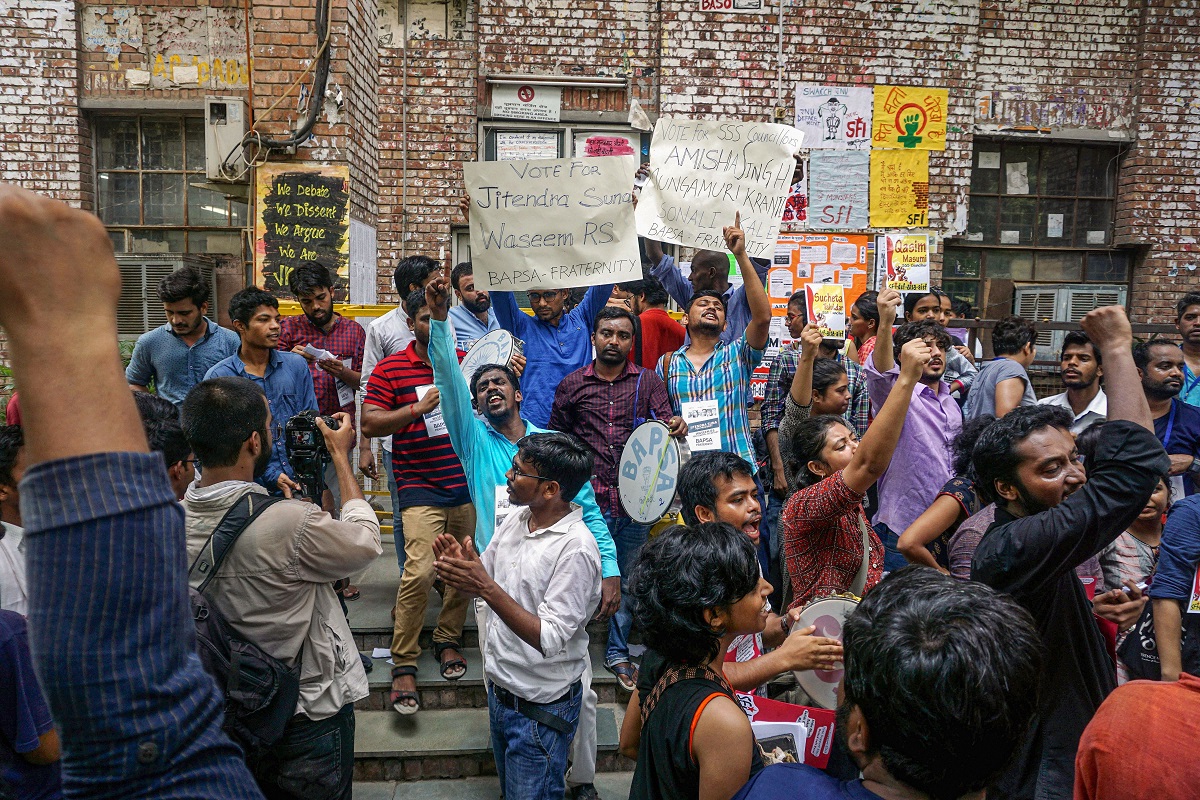
With chants, poetry, and political fire, the Jawaharlal Nehru University (JNU) presidential debate turned into a five-hour marathon of ideological clash and student activism on Wednesday night, setting the tone for Thursday’s students’ union elections. The campus amphitheatre pulsed with energy as supporters beat dhaplis and drums, waved flags, and shouted slogans. Cries of “Kashmir hamara hai” and “Hindu lives matter” from the Akhil Bharatiya Vidyarthi Parishad (ABVP) clashed with chants of “Azadi” and the sight of a Palestinian flag from the All India Students Association (AISA) camp.
Posters raised issues that continue to simmer on the campus: missing hostel allocations, funding gaps, and JNU’s evolving identity. Portraits of Jawaharlal Nehru peeked through the crowd, a reminder of the university’s founding ethos.
A night of arguments and allegiances
The debate began at 11:30 pm and continued until 4 am, with each of the 13 candidates given ten minutes to speak. The Election Committee intervened repeatedly to manage the din and ensure proceedings remained audible. Before the speeches, a two-minute silence was observed for the 26 people killed in the Pahalgam terror attack. But it was ABVP’s presidential candidate, Shikha Swaraj, who directly invoked the incident during her speech. “To those who say terrorism has no religion — were the victims not asked their faith?” she asked. Calling out the Left, she declared, “Andhera hai, raat hai… laal andhera chhantega,” positioning ABVP as the rising sun on campus.
Retorts from the Left and Centre
- AISA’s Nitish Kumar pushed back hard: “This is no mayoral election in Chandigarh to be rigged. This is JNU!” he said, before reciting lines from Faiz Ahmed Faiz’s poetry to underline the resistance spirit.
- NSUI’s Pradeep Dhaka took a broader political route, weaving in Adani, Trump, Punjab’s farmers and the Constitution. “The Constitution will run this country, not any organisation,” he said.
- AIDSO’s Suman focused on academic issues: “No journals in the library. No funds. We are forced to take loans from HEFA. We need to do politics like Bhagat Singh and Subhash,” she said, criticising the corporatisation of education.
- Independent candidates also spoke, often drowned by noise but not unnoticed, criticising both Left and Right for sidelining students’ day-to-day concerns.
New alignments, old battleground
The political equations have shifted this year. AISA has allied with the Democratic Students’ Federation (DSF), while the Students’ Federation of India (SFI), Birsa Ambedkar Phule Students’ Association (BAPSA), All India Students’ Federation (AISF), and Progressive Students’ Association (PSA) have formed another bloc.
ABVP has fielded a full panel: Shikha Swaraj (President), Nittu Goutham (Vice-President), Kunal Rai (General Secretary), and Vaibhav Meena (Joint Secretary). From the AISA-DSF side: Nitish Kumar (President), Manisha (Vice-President), Munteha Fatima (General Secretary), and Naresh Kumar (Joint Secretary).
High stakes, personal politics
With 7,906 students eligible to vote, 57% male and 43% female, the contest is both wide and intensely personal. Polling will be held in two sessions on April 25, from 9 am to 1 pm, and again from 2:30 pm to 5:30 pm. Counting will begin that night, with results expected by April 28.
Whether it was a demand for free Palestine or better hostels, the presidential debate proved once again that in JNU, politics isn’t just debated — it’s lived, felt, and fiercely expressed.
(With PTI inputs)
